





Welcome back to TGIF! Great to see you again. Grab a coffee and settle in, because this week Nia is walking us through how to choose the right FME Flow deployment architecture.
This post goes out to all the admins weighing their options and trying to find the best fit for their organization. Consider this your shortcut: we're here to save you some time.
Whether you’re installing FME Flow for the first time or looking to revamp your existing deployment architecture, you may have seen these excellent guides on choosing the best deployment type for you.
But if you want a quick, no-nonsense tool to help you choose the right FME Flow deployment architecture, look no further. We’ve designed a decision tree based on what sets the deployment types apart to identify which one will help you meet your workflow needs, SLAs, and scaling goals.
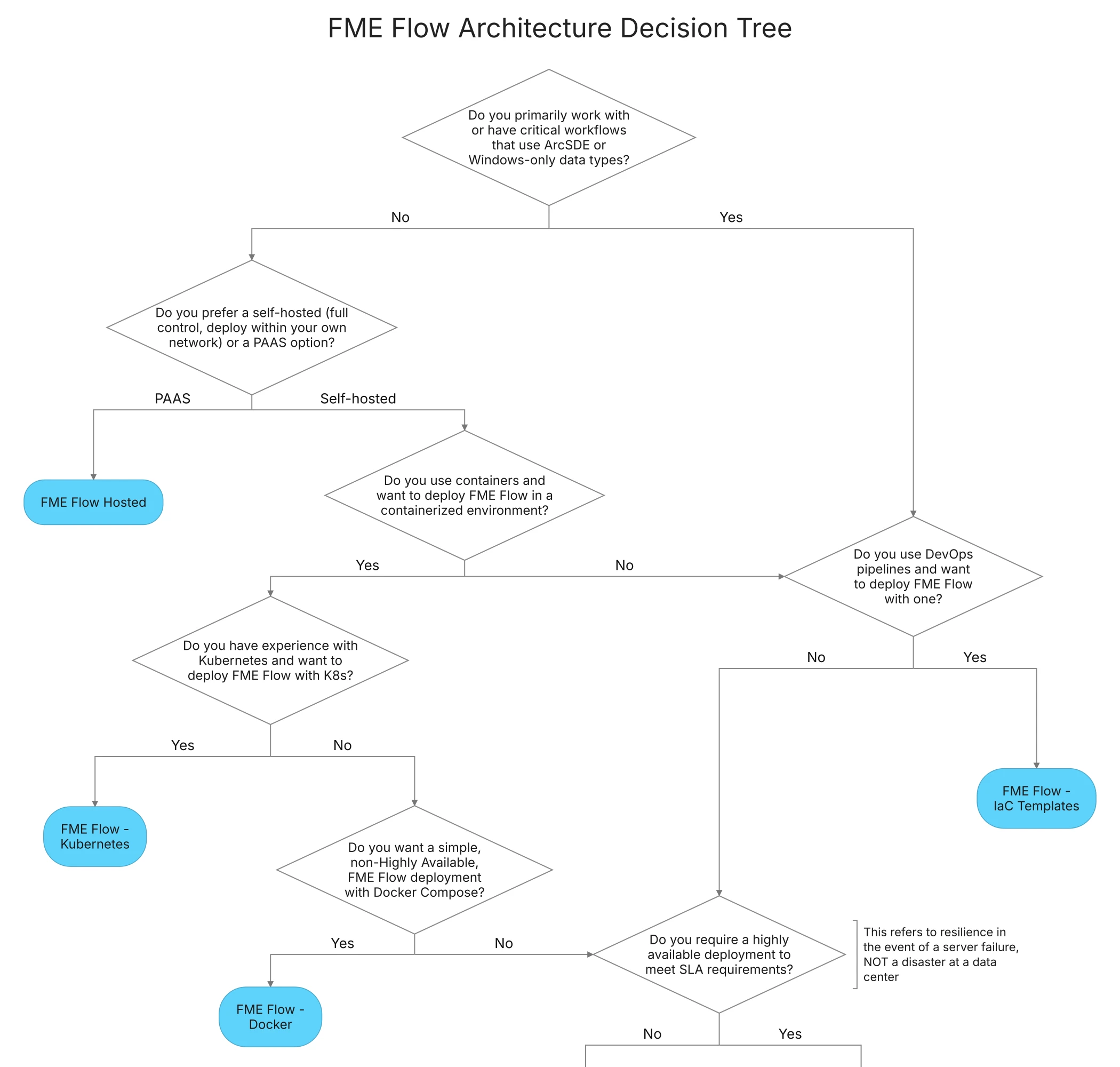
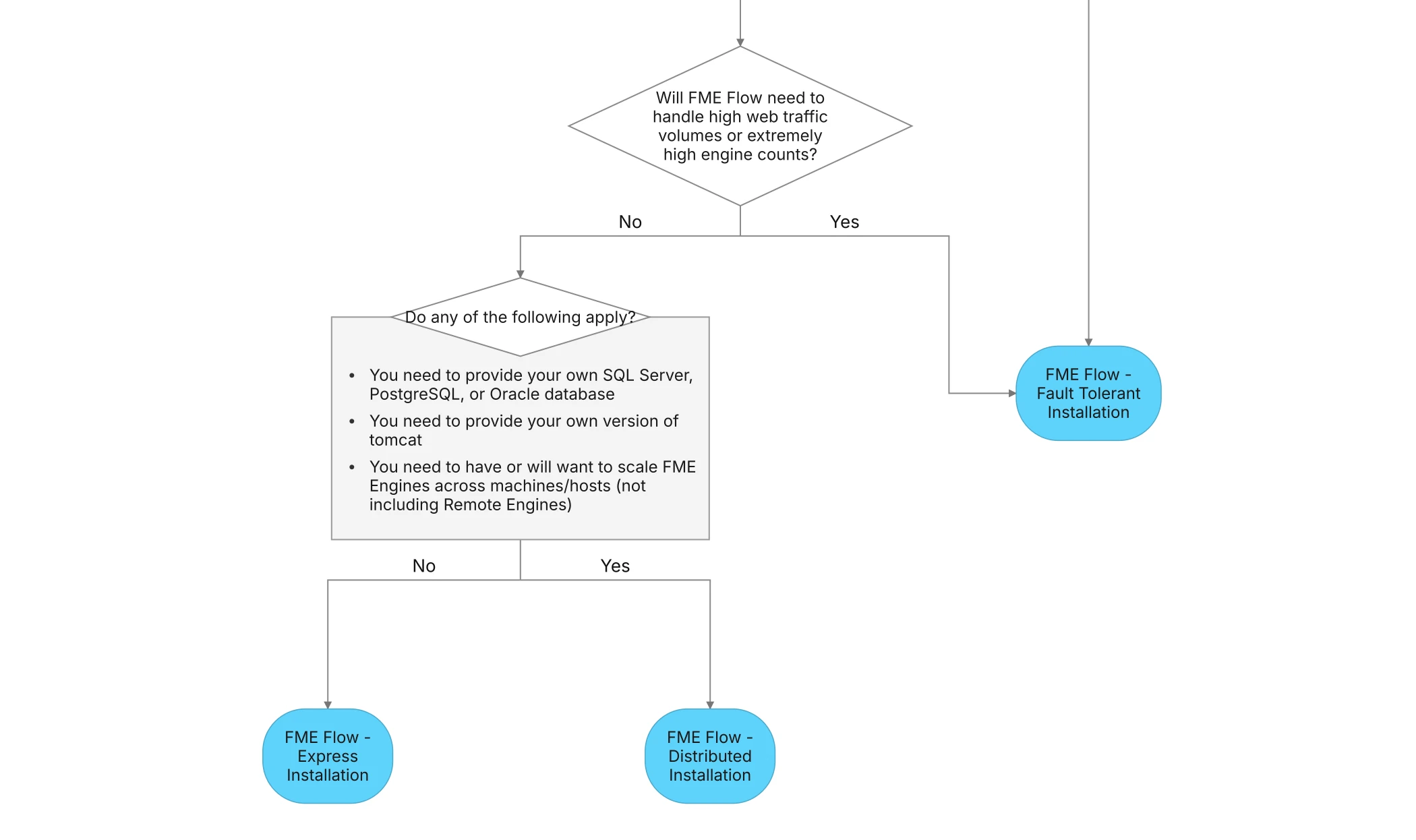
Click here to download the PDF
Interpreting Your Results
Once you’ve gone through the decision tree and gotten a suggested deployment type, read on to learn more about it.
We recommend reviewing all options, as your result is just a suggestion and other deployment architectures might suit your needs.
FME Flow Hosted
FME Flow Hosted is a PAAS option that we host and maintain on your behalf. For that reason, it’s one of the easiest deployment types to get started with.
FME Flow Hosted is Linux-based, so this deployment type is not a good fit for organizations using either Windows-only data formats or ArcSDE.
To see whether FME Flow Hosted supports your data types, check out our data formats and integrations reference.
If you want to use FME Flow Hosted but it doesn’t support all of your data types, check out the remote engines section below.
For more information about FME Flow Hosted, see these resources.
- Getting Started with FME Flow Hosted
- FME Flow Hosted vs On Prem: 5 Use Cases that Make the Cloud Worth It
FME Flow - Kubernetes (K8s)
FME Flow can be deployed with Kubernetes to take advantage of its powerful scaling and self-healing capabilities. Containerized environments are gathering interest lately; however, we never recommend deploying FME Flow with K8s if you do not have prior experience with it. These environments are high complexity and can be harder to troubleshoot.
With FME Flow on Kubernetes, you can configure your nodes to achieve various architectures:
- Single core: The most common structure. For smaller environments, including those where all pods are on one node.
- High Availability: Multiple core and queue pods are hosted on different nodes for redundancy. Engine pods share these nodes.
- Scaled Engines: Engines pods can be scaled up on a dedicated node, where they do not compete for resources with other components.
Note: RWX volume types are recommended for high availability and scaled engine architectures, which can increase the cost of this deployment type.
FME Flow on Kubernetes is Linux-based, so this deployment type is not a good fit for organizations using either Windows-only data formats or ArcSDE.
To see whether FME Flow on Kubernetes supports your data types, check out our data formats and integrations reference.
For more information about FME Flow on Kubernetes, see these resources.
- FME Flow Deployment 101: Docker and Kubernetes Explained
- Getting Started with FME Flow and Kubernetes
FME Flow - Docker Compose
FME Flow can be deployed with Docker Compose for a containerized installation that is easy to debug and deploy. Containerized environments are gathering interest lately, and FME Flow on Docker is a great fit for smaller environments, testing, or organizations looking to build confidence with containerization.
FME Flow on Docker utilizes a single host, and volumes persist outside the containers on that host. With FME Flow on Docker, you can scale engines vertically and/or provide an external PostgreSQL database on the same host, too.
FME Flow on Docker is Linux-based, so this deployment type is not a good fit for organizations using either Windows-only data formats or ArcSDE.
To see whether FME Flow on Docker supports your data types, check out our data formats and integrations reference.
For more information about FME Flow on Docker, see these resources.
FME Flow - IaC Templates
Using our IaC templates to deploy FME Flow will allow you to reliably reproduce your architecture across multiple environments and integrate your FME Flow deployments with CI/CD workflows.
Our IaC templates provide you with a baseline distributed deployment you can customize to suit your own needs. Completing the templates and reviewing the architecture, services, and associated costs is up to you.
Our templates are currently available for Windows machines.
For more information about IaC templates, see these resources.
- Infrastructure as Code (IaC) for Distributed FME Flow Deployments in the Cloud
- Automate Your FME Flow Deployment With These DevOps Practices
- Automation in Action: Accelerating Your FME Flow Deployment With CI/CD
FME Flow - Express
An express deployment installs all of FME Flow’s components on a single host machine. It’s a great choice for those who want simplicity and plan to scale their engines vertically on the same host machine. You must use the database and web application server shipped with the installer.
Express FME Flow deployments can be installed on Windows and/or Linux servers.
For more information on express installations, see these resources:
For a one-click deployment solution, please see our marketplace offerings:
FME Flow - Distributed
A distributed FME Flow deployment is the most flexible deployment option. With it, you can…
- Host FME Flow’s components on the same machine or broken out across multiple.
- Scale engines vertically on existing hosts, or horizontally by adding additional engine hosts. Other engine hosts may even use a different OS.
- Provide your own Apache Tomcat version for the web application server (the selected version must be compatible with your version of FME).
- Provide your own Oracle, SQL Server, or PostgreSQL database.
- Transition to a fault tolerant deployment later by installing another core and web application server on a different machine.
Distributed FME Flow deployments can be installed on Windows and/or Linux servers. All host machines must be hosted on the same data center and on the same network.
For more information on distributed deployments, see these resources:
- Distributing FME Flow Components
- A Guide to Choosing Your FME Flow Deployment Architecture
- Choosing a Deployment Architecture
For a one-click deployment solution, please see our marketplace offerings:
FME Flow - Fault Tolerant
A fault-tolerant deployment could be considered a type of distributed deployment where redundant core and web application server hosts sit behind a load balancer. They are capable of handling extremely high engine counts and web traffic.
If one core/web application host goes down in a fault-tolerant installation, the load balancer directs traffic to the remaining web application server. You must provide your own load balancer. Using a High Availability database and system share is also recommended.
For more information on fault tolerant deployments, see these resources:
- Planning for Fault Tolerance
- Using a Load Balancer With a Fault-Tolerant FME Flow
- FME Flow Architecture: Fault Tolerance vs Disaster Recovery
Remote Engines
FME Flow’s remote engine service is an optional addition to an existing FME Flow deployment. Remote engines allow you to deploy engines…
- In different data centers
- With different operating systems, which can expand the data formats you’re able to work with
- On separate networks
- In environments with very few open ports
Remote engines communicate with the primary FME Flow installation over the web application server port, which is typically 80/443.
To learn more about remote engines, see these resources:
- A Guide to Choosing Your FME Flow Deployment Architecture
- Leverage Remote Engine Service in FME Flow
- Remote Engine Services
Disaster Recovery
Disaster recovery is the ability for FME Flow to recover if an entire data center goes down. If your organization requires disaster recovery, please see these resources:
Related Resources
- Introduction to FME Flow
- FME Flow Deployments
- Scaling FME Flow: Vertical, Horizontal, and Advanced Approaches
Next Steps
Once you’ve selected the right deployment type, you’re ready to plan your FME Flow installation. These resources will help you map out networking requirements, service accounts, and more.
- Locked Down by Design: Security Architecture, Access, and Everything In Between
- FME Flow Administration: Post Installation Configurations
- FME Flow Best Practices: Guide For IT Ops and Flow Admins
Conclusion
We hope this flow chart helped you understand the key differences between FME Flow’s different deployment options and select the right one for you.
That's all for this week! Friendly reminder: no Friday deployments. Let the weekend be the only thing going live. See you next week!