



New

Convert feature to JSON

Related products:FME FormTransformers
  • September 11, 2025
  • 11 replies
  • 168 views

nic_ran
Contributor
Forum|alt.badge.img+16

With the advent of Data Virtualization it seems like a good time to improve JSON support in FME!

It would be great if there was a simple way to convert a feature to JSON format so that all attributes on the feature become elements in the JSON object and all lists items are converted to arrays in the JSON object.

The result should be output to an attribute.

I know that it’s possible to do this currently using the JSONTemplater but it requires manually building the template and it would be nice to avoid that. Just do whatever cleanup of attributes is required using the AttributeManager, then have FME convert to JSON without requiring extra input. The JSONTemplater can still be used for more complex cases.

(I know that it’s also possible to use the JSON writer to create a simple file from a feature but this does not support lists/arrays and requires writing out to the filesystem.)


11 replies

NickAtSafe
Safer
Forum|alt.badge.img+10
  • Safer
  • September 12, 2025

Hey ​@nic_ran - I was fussing with something very similar just yesterday. I ended up doing a really quick and simply python caller to take all the attributes and turn it into a json object (one per feature). It’s not very robust, doesn’t support lists or sub-objects, but it did help me out in the task I was doing.
 

import json
import fme
from fme import BaseTransformer
import fmeobjects


class FeatureProcessor(BaseTransformer):
def __init__(self):
pass

def has_support_for(self, support_type: int):
return support_type == fmeobjects.FME_SUPPORT_FEATURE_TABLE_SHIM

def input(self, feature: fmeobjects.FMEFeature):
# Extract all attributes from the feature
attributes = feature.getAllAttributeNames()

# Create a dictionary to hold the attribute-value pairs
attribute_dict = {}
for attr in attributes:
attribute_dict[attr] = feature.getAttribute(attr)

# Convert the dictionary to a JSON string
json_string = json.dumps(attribute_dict)

# Add the JSON string as a new attribute '_json'
feature.setAttribute("_json", json_string)

# Output the feature
self.pyoutput(feature, output_tag="PYOUTPUT")

def close(self):
pass

def process_group(self):
pass

def reject_feature(self, feature: fmeobjects.FMEFeature, code: str, message: str):
feature.setAttribute("fme_rejection_code", code)
feature.setAttribute("fme_rejection_message", message)
self.pyoutput(feature, output_tag="<Rejected>")


virtualcitymatt
Celebrity
Forum|alt.badge.img+47

Yeah I have the same wish - You can recursively flatten a json feature and it will use the dot notation for objects and sub objects and for arrays you get lists. It would be great to have something that will do the reverse.

Just making small changes to JSONObjects with the JSONUpdator is doable, however, it can be just a lot of configuration and it’s a bit sensitive. 

I work with JSON all the time and I don’t think the JSON writer has ever actually be helpful for me.   


alexbiz
Influencer
Forum|alt.badge.img+30
  • Influencer
  • September 12, 2025

Although it doesn't quite achieve what you want, have you looked at my custom DataVirtualizationJSON* transformers?

https://hub.safe.com/publishers/abizien/transformers/datavirtualizationjsonlist

https://hub.safe.com/publishers/abizien/transformers/datavirtualizationjsonpaginate

https://hub.safe.com/publishers/abizien/transformers/datavirtualizationgeojson


I thought about making a custom transformer that would do the equivalent of a json.dump(), but an FME feature often drags unexposed attributes you don't want to include in the result.

So you have to allow selection of the attributes you want to include in the JSON, and it is not necessarily simple to allow the selection and processing of list-type attributes.

I will take a deeper look at it though.


alexbiz
Influencer
Forum|alt.badge.img+30
  • Influencer
  • September 12, 2025

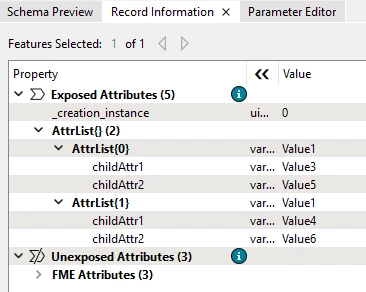
For more context on the issues with automatic conversion of FME entities to JSON, what should the JSON representation of this list be?

The FME data model combines the concepts of list and object


virtualcitymatt
Celebrity
Forum|alt.badge.img+47
{
"_creation_insntace": 0,
"AttrList": [
"Value1",
{
"childAttr1": "Value3",
"childAttr2": "Value5"
},
"Value1",
{
"childAttr1": "Value4",
"childAttr2": "Value6"
}
]
}

This would be one option. Am I missing something there? 


alexbiz
Influencer
Forum|alt.badge.img+30
  • Influencer
  • September 12, 2025

Well, then the indexes no longer match (and it's a pretty ugly - but conforming - JSON list)


alexbiz
Influencer
Forum|alt.badge.img+30
  • Influencer
  • September 12, 2025

Maybe it’s not really an issue, but a list with two elements becoming a list with four elements doesn’t seem proper to me.

And trying to convert it back to FME feature (with a JSONFlattener) would give AttrList{0-3} instead of AttrList{0-1}. So it might be a lossy process.


virtualcitymatt
Celebrity
Forum|alt.badge.img+47

Well, then the indexes no longer match (and it's a pretty ugly - but conforming - JSON list)

Agreed - But I don’t really see any other option for it - In the end there is actually not way to create this from json in FME so either skip out the values directly in the list (in the case there is an object) or throw an error. The user needs to makes sure their data is compatible I guess


nic_ran
Contributor
Forum|alt.badge.img+16
  • Author
  • Contributor
  • September 16, 2025

Hey ​@nic_ran - I was fussing with something very similar just yesterday. I ended up doing a really quick and simply python caller to take all the attributes and turn it into a json object (one per feature). It’s not very robust, doesn’t support lists or sub-objects, but it did help me out in the task I was doing.
 

import json
import fme
from fme import BaseTransformer
import fmeobjects


class FeatureProcessor(BaseTransformer):
def __init__(self):
pass

def has_support_for(self, support_type: int):
return support_type == fmeobjects.FME_SUPPORT_FEATURE_TABLE_SHIM

def input(self, feature: fmeobjects.FMEFeature):
# Extract all attributes from the feature
attributes = feature.getAllAttributeNames()

# Create a dictionary to hold the attribute-value pairs
attribute_dict = {}
for attr in attributes:
attribute_dict[attr] = feature.getAttribute(attr)

# Convert the dictionary to a JSON string
json_string = json.dumps(attribute_dict)

# Add the JSON string as a new attribute '_json'
feature.setAttribute("_json", json_string)

# Output the feature
self.pyoutput(feature, output_tag="PYOUTPUT")

def close(self):
pass

def process_group(self):
pass

def reject_feature(self, feature: fmeobjects.FMEFeature, code: str, message: str):
feature.setAttribute("fme_rejection_code", code)
feature.setAttribute("fme_rejection_message", message)
self.pyoutput(feature, output_tag="<Rejected>")


Thanks ​@NickAtSafe , I appreciate the reply and the source code. Definitely something could be done along those lines but it would be nice to see it as native FME functionality, including list support.


nic_ran
Contributor
Forum|alt.badge.img+16
  • Author
  • Contributor
  • September 16, 2025

Thanks for your replies ​@alexbiz and ​@virtualcitymatt , I appreciate the input to the discussion and really appreciate the work you’ve already done alexbiz on your data virtualization JSON transformers.

Working with FME list structures is often a pain point and I can see there are definitely complexities in converting them to JSON. The example you’ve given with top level list attribute values and child values does pose a problem but, to be honest, I don’t think I’ve ever actually seen a list that looks like that.

I think whatever solution can be built it should make a best attempt at creating conforming JSON. The user needs to take some responsibility for ensuring the feature attributes (and lists) make sense before converting to JSON.


lifalin2016
Supporter
Forum|alt.badge.img+40
  • Supporter
  • September 26, 2025

I just ran into this problem, but mistook it for a problem with encoding/decoding non-ASCII characters in DV, since it only erred when these were included.

I found a post from 5 years ago about it, and used the suggestion to manually build the JSON with other transformers, and this worked out just nicely. But it shouldn’t have to be this cumbersome.

I fully support serious work being done to remedy the shortcomings of the JSONTemplater. As it is now, it’s basically useless for anything but the simplest tasks. And yes, DV demands more.