The query below works in Dataloader and the Pentaho Kettle tool. But the Salesforce reader ignores the Parcel__r.xx fields. I see where @schatt15 posted here saying he used Dataloader in his SF Reader. But I don't see any option like that in SF reader. I'm using FME Workbench in ESRI 10.7 FME(R) 2019.0.0.0 (20190328 - Build 19238 - WIN32)
Thanks for your time.
Allan
Select
Parcel__r.MUSW__Street_Number__c,
Parcel__r.MUSW__Street__c,
Parcel__r.MUSW__City__c,
Parcel__r.MUSW__State__c,
Parcel__r.MUSW__Post_Zip_Code__c,
CreatedDate,NAME,Ordinance__c,
MUSW__Status__c,
MUSW__Corrected_Date__c,GRASS_SQ_FT__C,
Age__c,
Code_Enforcement_Area__c,
Safe_Clean__c
FROM MUSW__Violation__c
WHERE CreatedDate = LAST_N_DAYS:100
Best answer by jasonschroeder
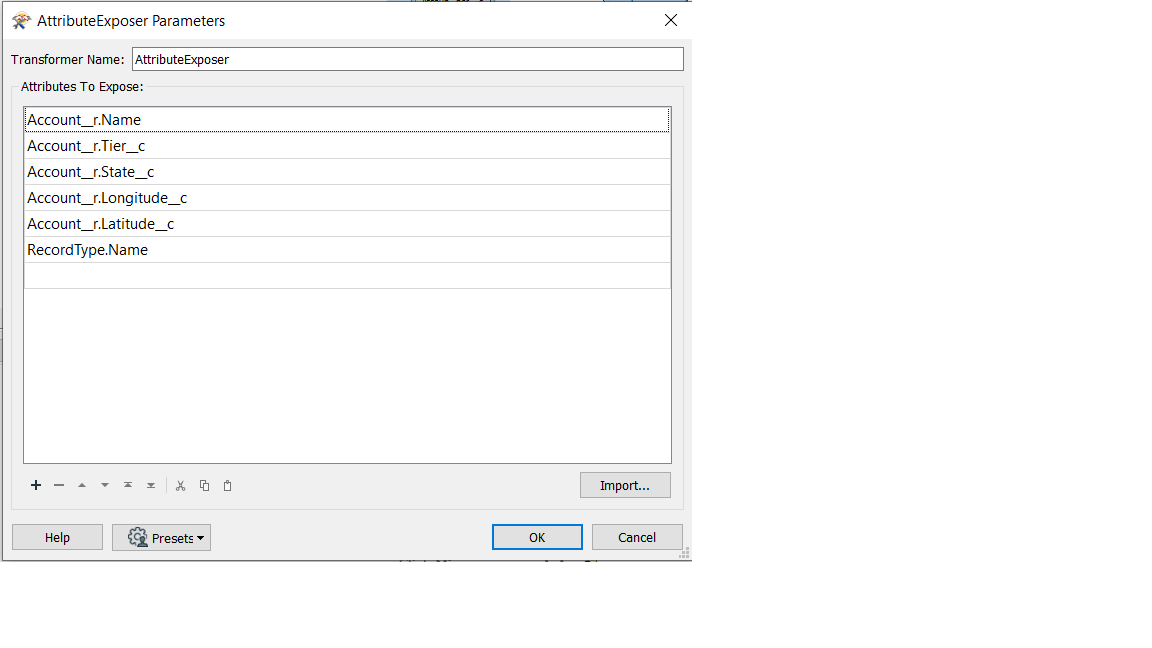
@alamberthampton @bruceharold You will need to use the AttributeExposer transformer to expose any fields that you are querying via a relationship - whether standard or custom relationships. Below image is an example from a Salesforce query:
Account__r.Tier__c (Example in Salesforce Reader query: SELECT Account__r.Tier__c, FROM Child_object__c)
Any fields that are present in the query that exist in the object you are querying from will automatically show up as attributes in the workbench, but those that you pull from relationships will need to be exposed in the below manner. Connect the AttributeExposer to the Salesforce Reader and expose the attributes from the custom relationship:
Parcel__r.MUSW__Street_Number__c
Parcel__r.MUSW__Street__c
Parcel__r.MUSW__City__c
Parcel__r.MUSW__State__c
Parcel__r.MUSW__Post_Zip_Code__c
Hope this helps!
This post is closed to further activity.
It may be an old question, an answered question, an implemented idea, or a notification-only post.
Please check post dates before relying on any information in a question or answer.
For follow-up or related questions, please post a new question or idea.
If there is a genuine update to be made, please contact us and request that the post is reopened.
@alamberthampton @bruceharold You will need to use the AttributeExposer transformer to expose any fields that you are querying via a relationship - whether standard or custom relationships. Below image is an example from a Salesforce query:
Account__r.Tier__c (Example in Salesforce Reader query: SELECT Account__r.Tier__c, FROM Child_object__c)
Any fields that are present in the query that exist in the object you are querying from will automatically show up as attributes in the workbench, but those that you pull from relationships will need to be exposed in the below manner. Connect the AttributeExposer to the Salesforce Reader and expose the attributes from the custom relationship:
@alamberthampton @bruceharold You will need to use the AttributeExposer transformer to expose any fields that you are querying via a relationship - whether standard or custom relationships. Below image is an example from a Salesforce query:
Account__r.Tier__c (Example in Salesforce Reader query: SELECT Account__r.Tier__c, FROM Child_object__c)
Any fields that are present in the query that exist in the object you are querying from will automatically show up as attributes in the workbench, but those that you pull from relationships will need to be exposed in the below manner. Connect the AttributeExposer to the Salesforce Reader and expose the attributes from the custom relationship:
Parcel__r.MUSW__Street_Number__c
Parcel__r.MUSW__Street__c
Parcel__r.MUSW__City__c
Parcel__r.MUSW__State__c
Parcel__r.MUSW__Post_Zip_Code__c
Hope this helps!
Thanks @jasonschroeder That works perfectly. For future readers... you have to type in or paste these .r field names to the AttributeExposer...and select the regular fields. In the above example, he typed or pasted the first 5 and selected the last 1.
Thanks @jasonschroeder That works perfectly. For future readers... you have to type in or paste these .r field names to the AttributeExposer...and select the regular fields. In the above example, he typed or pasted the first 5 and selected the last 1.

 Hope this helps!